
What is Rental Cash Damming?
"Rental Cash Damming (RCD) is a CRA-compliant financial strategy under section 20(1)(c) of the Income Tax Act (ITA) where a Canadian property owner uses gross rental income to pay down non-deductible primary mortgage principal, while borrowing from an Investment Line of Credit (ILOC) to pay rental property operating expenses—effectively transforming non-deductible debt into tax-deductible debt."
If your home mortgage renewal is coming up in the next 6 to 12 months, your natural instinct is probably to do what 95% of Canadians do: hunt for the lowest advertised interest rate.
Finding a competitive rate matters. But obsessing solely over a fraction of a percent often costs real estate investors tens or even hundreds of thousands of dollars in missed wealth creation. Why? Because rate is only the cost of borrowing; structure dictates how much wealth you keep.
If you own a principal residence and at least one rental property in Canada, there is a legitimate, CRA-recognized financial architecture that can:
- Shave 10 to 15 years off your personal home mortgage.
- Convert hundreds of thousands of dollars of non-deductible personal debt into 100% tax-deductible investment debt.
- Generate four- to five-figure annual CRA tax refunds without asking you to invest a single extra dollar out of pocket or change your standard of living.
This strategy is known as Rental Cash Damming (RCD). Here is how it works, why the CRA permits it, and how to execute it seamlessly using an all-in-one banking facility like Manulife One.
1. The Core Problem: The “After-Tax Trap” of Your Home Mortgage
Every dollar you send to your home mortgage comes from after-tax income.
If you sit in a 43% marginal tax bracket, you must earn approximately $1.75 in pre-tax gross income just to put $1.00 toward your mortgage principal and interest. Worse yet, because your home is personal, the interest on that loan provides zero tax relief.
Meanwhile, what happens with your rental property?
- Your tenant pays you rent.
- You deposit that rent into a general chequing account.
- You immediately turn around and pay the rental mortgage, property taxes, insurance, and maintenance out of that same rental revenue.
- Whatever surplus remains sits, perhaps aimlessly, in your account.
This is the conventional landlord cycle, and financially, it is backwards.
By paying rental operating expenses with cold cash collected from tenants, you “waste” cash that could have been used to destroy your expensive, non-deductible personal debt.
2. What Exactly is Rental Cash Damming?
Rental Cash Damming flips the standard cash flow sequence on its head:
TRADITIONAL FLOW (Status Quo):
-
Rental: Tenant Rent ──▶ Rental Chequing Account ──▶ Pays Rental Expenses (Direct Cash)
-
Home Mortgage: Personal Paycheque ──▶ Slowly chips away at non-deductible Home Mortgage (25-30 yrs)
CASH DAMMING FLOW:
-
Tenant Rent (100%) ──▶ Available* to be injected directly as a prepayment on YOUR HOME MORTGAGE (Creates Equity)
-
Rental Operating Expenses ──▶ Paid directly from a dedicated Investment Line of Credit (ILOC)
Here is the step-by-step cash damming mechanism:
- Redirect Gross Rent: Every dollar of gross rent collected can immediately be applied as an extra lump-sum payment against your non-deductible principal residence mortgage. [*NB: In "pure" debt-conversion analysis (per the example below), we only apply the eligible rental operating expenses as the primary mortgage prepayment, not gross rents. But know that applying gross rents would further accelerate your home mortgage freedom day.]
- Dam Operating Expenses: To cover genuine rental property expenses (property taxes, insurance, condo fees, repairs, utilities, and mortgage payments on the rental), you borrow the exact amounts from a dedicated Investment Line of Credit (ILOC).
- The Debt Conversion: Your total household debt remains essentially the same in the early stages, but its character changes completely. Every month, non-deductible personal debt is destroyed, and an equal amount of tax-deductible investment debt takes its place.
- The Snowball: Because the borrowing on the credit line is directly traceable to income-producing rental expenses, the interest is tax-deductible. The resulting tax deductions generate annual CRA tax refunds, which you inject straight back into the home mortgage to accelerate the payoff even faster.
3. Is This Legal? What the CRA and Supreme Court Say
Many investors ask: "Does the CRA really allow this? Isn't this an artificial tax shelter?"
The answer is an unequivocal yes, it is completely legal. In Canada, interest deductibility is governed by Section 20(1)(c) of the Income Tax Act (ITA). Under Canadian tax law, interest deductibility is determined by the current use of borrowed funds (the "Purpose Test"), never by the collateral securing the loan:
- If you borrow money to buy groceries or pay your home mortgage, the interest is not deductible.
- If you borrow money directly to pay expenses incurred for the purpose of earning income from a business or property (such as rental expenses), the interest is 100% tax-deductible.
The Singleton Precedent (Supreme Court of Canada)
The legal bedrock of cash damming was settled by the Supreme Court of Canada in the landmark case Singleton v. Canada [2001] 2 S.C.R. 1046.
Lawyer John Singleton withdrew capital from his law partnership to purchase a personal home. He then immediately borrowed an identical amount against the home to refinance his capital account in the law firm. The CRA challenged the deduction, arguing it was an artificial scheme to make a personal mortgage deductible.
The Supreme Court ruled firmly in Mr. Singleton's favor, establishing that taxpayers are entitled to arrange their financial affairs within the law to minimize tax. As long as the borrowed funds are strictly and demonstrably used for an eligible income-earning purpose, the interest is deductible.
The Golden Rule: Pristine Audit Trails
To withstand CRA scrutiny, you cannot commingle funds:
- You must not draw from the credit facility for personal groceries, family vacations, or personal credit card payments.
- Every single withdrawal from the credit line must match an invoice, receipt, or property tax bill tied directly to your rental property.
4. Who Is the Ideal Candidate for Rental Cash Damming?
Rental Cash Damming is not for everyone. It requires discipline, the right mortgage structure, and specific real estate criteria:
- Real Estate Investors with Personally Owned Properties: You own your principal residence plus at least one residential rental property (or an unincorporated small business/sole proprietorship). Note: If your rentals are held inside a Canadian Controlled Private Corporation (CCPC), the mechanics differ and require corporate debt restructuring.
- Sizable Personal Mortgage Balance: You have an outstanding mortgage on your principal residence ($300,000 to $1,000,000+).
- Higher Marginal Tax Bracket: Combined federal and provincial marginal rate of 35% to 50%+. The higher your tax bracket, the larger your annual CRA refund cheque.
- Sufficient Equity or Re-advanceable Capacity: You have equity in your properties to support a secured line of credit.
- Disciplined Record-Keepers: Landlords who can keep clean accounting records or who want an automated framework that handles the separation for them.
5. The Weapon of Choice: The Manulife One Offset Account
Why doesn't every Canadian landlord do this? Because executing this through a traditional Big-5 bank chequing account and a rigid standard mortgage is an administrative nightmare. Traditional mortgages restrict annual prepayments (often capping them at 10%–20% per year) and do not automatically re-advance borrowing room dollar-for-dollar as you pay them down.
This is where the Manulife One ("M1") account acts as the ultimate cash damming engine:
- Integrated Sub-Account Architecture: Manulife One allows you to establish separate, firewalled tracking sub-accounts under one global umbrella. You have your main personal balance, alongside a dedicated, standalone Rental Operating Sub-Account (ILOC).
- Automated Dollar-for-Dollar Re-advancement: As your tenant's rent reduces your personal home balance, available credit is immediately unlocked in your investment sub-account.
- Audit-Proof CRA Statements: Manulife One produces month-by-month statements clearly isolating your tax-deductible investment borrowing and accrued interest from personal cash flows. When tax season arrives, your accountant has an airtight paper trail ready for Schedule 77 (Statement of Real Estate Rentals).
- Daily Simple Interest Offset: Every dollar of rent sitting in your main (personal) M1 account immediately offsets interest on a daily basis before outgoing expenses leave, driving interest costs down further.
6. Real-World Case Study: See the Numbers in Action
Let’s look at a realistic scenario modeled directly in our Richards Mortgage Group RCD Diagnostic Engine:
The Client Profile:
- Primary Residence Mortgage: $450,000 at 4.99% (25-Year Baseline Amortization)
- Standard Monthly Payment: $2,614.66 / month
- Rental Property Revenue: $2,800 / month gross rent
- Eligible Rental OpEx: $1,750 / month (property taxes, insurance, maintenance, rental debt servicing)
- Marginal Tax Rate: 43.00%
- Investment Line of Credit "ILOC" Rate: 5.2% (Effective After-Tax Cost: 2.964%)
- CRA tax refunds: strategy-created CRA refunds are put against the Primary Residence Mortgage annually. Rental surplus is not used in this example.
The Results: Status Quo vs. Rental Cash Damming
| Milestone Dimension | Traditional Mortgage (Status Quo) | With Rental Cash Damming (RCD) | The Investor Advantage |
|---|---|---|---|
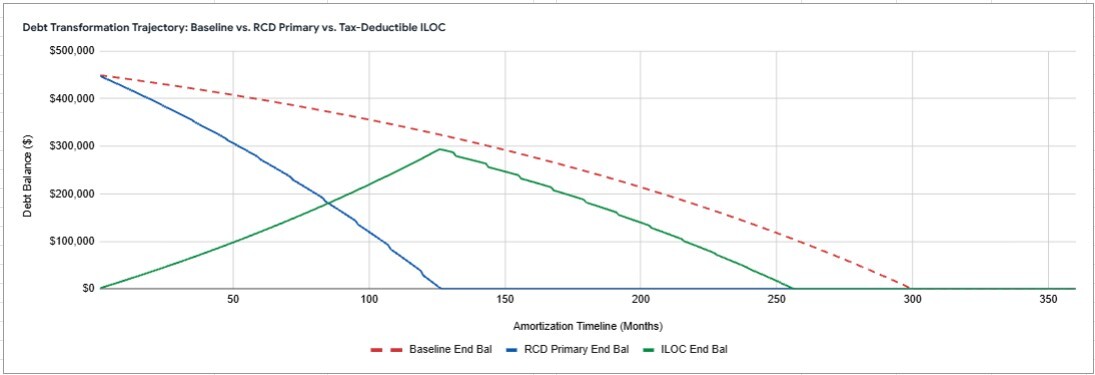
| Primary Mortgage Freedom | 25.0 Years (300 Months) | 10.6 Years (127 Months) | 14.4 Years Faster! |
| Non-Deductible Debt at end of Yr 10 | $331,972 | $28,522 | $303,450 Less "Bad" Debt |
| Cumulative CRA Tax Refunds (Yr 5) | $0 | $6,509 | Direct cash back from CRA |
| Cumulative CRA Tax Refunds (Yr 15) | $0 | $55,772 | Pure CRA tax recovery |
| Total Non-Deductible Interest Saved | $0 | $203,344 | Interest NOT paid with after-tax dollars |
| Net Household Wealth Unlocked | Baseline | $111,297+ | Clear financial gain: RCD minus Status Quo |
By mid-year 10, the primary residence mortgage (the blue line in the graph below and paid with after-tax dollars) is completely eliminated. The homeowner now owns their primary residence free and clear, and all remaining debt (the green line - Investor Line of Credit) is 100% tax-deductible. The former mortgage payment and ongoing tax refunds can now be redirected to crush the remaining deductible debt or acquire more assets.
7. Approaching Mortgage Renewal? Don’t Just Shop Rates—Shop Strategy
This brings us back to our central theme: Upcoming Mortgage Renewal: Before You Just Seek Out the Lowest Rate, Consider These Other Things.
When your mortgage lender sends you a renewal slip in the mail offering you 50 basis points off their posted rate, understand what they are offering: a standard, rigid amortization product designed to keep you paying non-deductible interest for decades.
A slightly lower interest rate on a poorly structured mortgage will save you a few hundred dollars a year. A properly structured Cash Damming mortgage on a Manulife One facility can save you thousands in interest (over $111,000 in our example), shave years off your mortgage, and hand you thousands of dollars in tax refunds.
See Your Exact Numbers: Book Your Free Custom RCD Diagnostic
You don’t have to guess whether this strategy works for your portfolio. We have built a proprietary Rental Cash Damming Financial Engine that calculates your exact amortization timeline, tax deduction trajectory, and interest savings down to the cent.
Choose How You Want to Review Your Strategy:
- Option A: Personalized Video Breakdown (Asynchronous & Zero Pressure)
Book a preliminary call, then send us your current primary mortgage balance, contract rate, and rental property monthly figures. We will plug your numbers into the diagnostic engine and record a custom 7-minute screenshare video walking you through your specific roadmap. Watch it on your own time, with zero sales pitch. - Option B: Live 1-on-1 Video Meet Strategic Session(GoogleMeet or Zoom)
Prefer an interactive walk-through? Book a 25-minute live screen-share session. We’ll open the financial model live, stress-test different interest rate scenarios, adjust your tax brackets, and show you exactly what your debt freedom date looks like.
👉 [Click Here to Book Your Free Custom RCD Diagnostic & Strategy Review]
Richards Mortgage Group | Strategic Debt Conversion & Mortgage Planning for Canadian Real Estate Investors. Joel Richards is a Smith Manoeuvre Certified Professional (SMCP), which is a financial/tax strategy accreditation.
Disclaimer: This article is for educational and illustrative purposes only and does not constitute formal legal, accounting, or tax advice. Interest deductibility under CRA guidelines requires strict adherence to ITA s. 20(1)(c) and pristine record keeping. Borrowers should consult with a licensed mortgage broker and a qualified Canadian CPA before implementing debt conversion strategies.

